BEGIN:VCALENDAR
VERSION:2.0
X-WR-CALNAME;VALUE=TEXT:Titian, Philip and the Poesie: The Artist, The Patron | Miguel Falomir (Museo Nacional del Prado) | Keynote Lecture Visual Poetry
PRODID:-//Harvard events data//EN
BEGIN:VEVENT
UID:event_1429893_0
SUMMARY:Titian, Philip and the Poesie: The Artist, The Patron | Miguel Falomir (Museo Nacional del Prado) | Keynote Lecture Visual Poetry
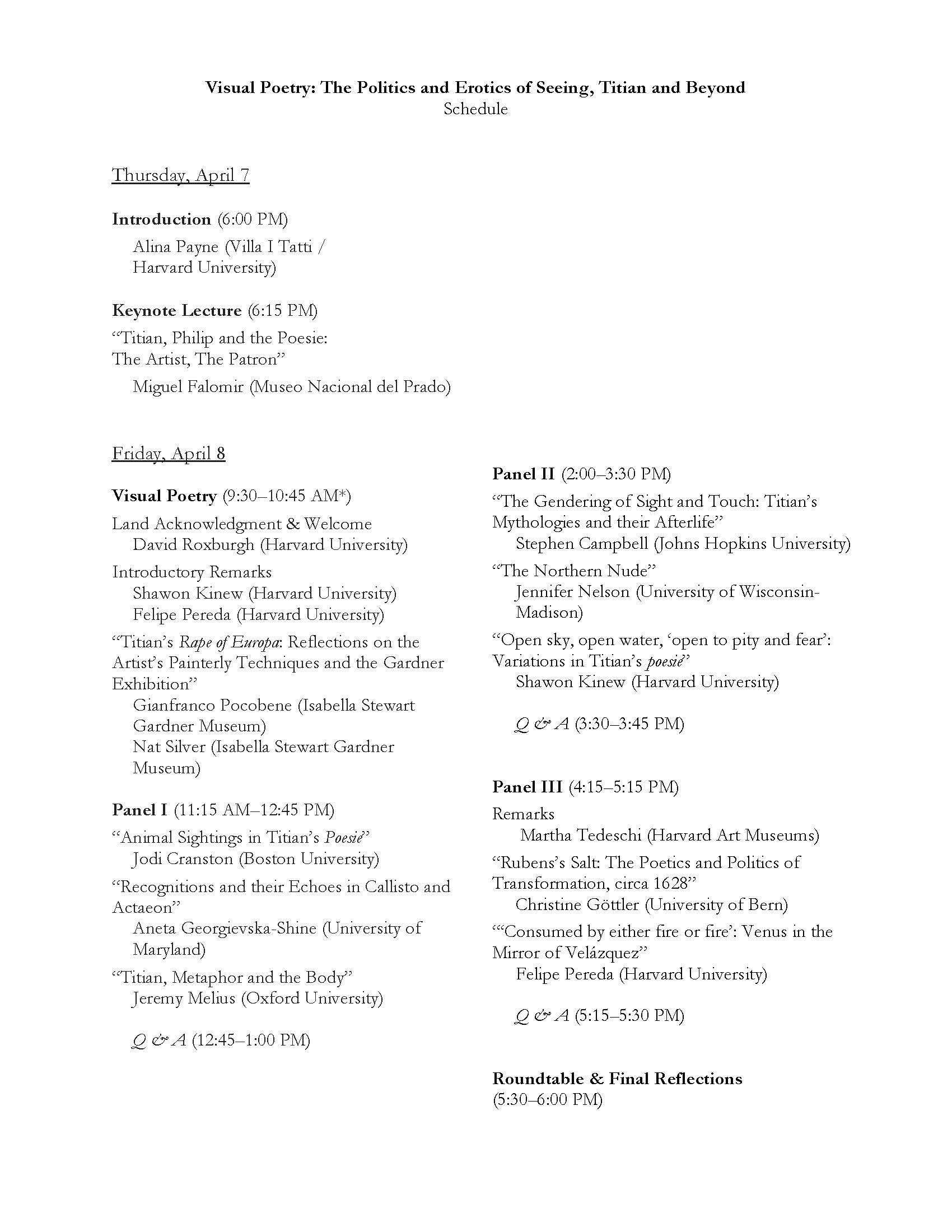
DESCRIPTION:<p style="margin:0in">	<img src="https://haa.fas.harvard.edu/files/history-artsarchitecture/files/rsz_2titians_visual_poetry_poster_2.jpg?m=1647877928"></p><p style="margin:0in">	<strong>Titian, Philip and the <em>Poesie:</em> The Artist, The Patron</strong></p><p style="margin:0in">	Miguel Falomir (Museo Nacional del Prado)</p><p style="margin:0in">	Keynote Lecture</p><p style="margin:0in">	<span style="background:white"><span style="color:#1e1e1e">Visual Poetry: The Politics and Erotics of Seeing, Titian and Beyond</span></span></p><p style="margin:0in">	 </p><p style="margin:0in">	<strong>Thursday, April 7, 2022</strong></p><p style="margin:0in">	<strong>6pm</strong></p><p style="margin:0in">	 </p><p style="margin:0in">	<span style="background:white"><span style="color:#1e1e1e"><span style="font-variant-ligatures:normal"><span style="orphans:2"><span style="widows:2"><span style="text-decoration-thickness:initial">In person &amp; streaming.</span></span></span></span></span></span></p><p style="margin:0in">	<span style="background:white"><span style="color:#1e1e1e"><span style="font-variant-ligatures:normal"><span style="orphans:2"><span style="widows:2"><span style="text-decoration-thickness:initial">- </span></span></span></span></span></span><a data-url="https://harvard.zoom.us/webinar/register/WN_-YM57LbnSPW6e_kBBSDb5g" href="https://harvard.zoom.us/webinar/register/WN_-YM57LbnSPW6e_kBBSDb5g" title="">Register for streaming here.</a></p><p style="margin:0in">	 </p><p style="margin:0in">	<span style="background:white"><span style="color:#1e1e1e"><span style="orphans:2"><span style="widows:2"><span style="caret-color:#1e1e1e">Miguel Falomir’s lecture is the first event of the</span></span></span> </span></span><a href="https://bit.ly/titianvisualpoetry" style="orphans:2;widows:2"><span style="background:white"><span style="color:#215990">two-day conference Visual Poetry: The Politics and Erotics of Seeing, Titian and Beyond.</span></span></a></p><p style="margin:0in">	 </p><p style="margin:0in">	<em>".. interim che metto al ordine le poesie..."</em></p><p style="margin:0in">	<span style="background:white"><span style="color:#1e1e1e">“...while I work on the <em>Poesie..</em>.” </span></span></p><p style="margin:0in">	 </p><p style="margin:0in">	<em>Poetry:</em><span style="background:white"><span style="color:#1e1e1e"> this<em> </em>is how Titian referred to his mythological paintings in a now famous letter written from Venice in 1553 to his patron, Philip II. Titian’s use of the term speaks of the humanistic culture that modelled an approach to an art of vitality and power, one of mythology and the nude intertwined in painting. Both artist and patron collaborated in its creation and in the construction of the erotic gaze, understood as “visual poetry”.</span></span></p><p style="margin:0in">	 </p><p style="margin:0in">	<span style="background:white"><span style="color:#1e1e1e">Treasured behind curtains hanging in the private apartments of Madrid's Royal Alcázar, Titian’s paintings comprised one of the most exquisite collections of erotic painting of the early modern period. The paintings’ force was felt. Admired by a select number of visitors, the <em>poesie </em>were copied and widely interpreted by painters, such as Peter Paul Rubens<em>. </em>As their steward and custodian, Diego Velázquez carefully studied them, arguably becoming the inheritor and innovator of this tradition.</span></span></p><p style="margin:0in">	 </p><p style="margin:0in">	<span style="background:white"><span style="color:#1e1e1e">Taking the <em>poesie </em>as a point of departure, <em>Visual Poetry: The Politics and Erotics of Seeing </em>will<em> </em>investigate the invention and significance of erotic visual culture in early modern Europe, reflecting on its artistic afterlife. The conference will address the diverse relationships of the humanistic tradition and Antiquity with erotic painting since the Renaissance. Papers will consider pressing questions of the representation of sexuality and violence in the art of this period, the nature of their spectatorship, and the political dimension of<span style="border:nonewindowtext1.0pt"> Titian</span>’s <em>poesie</em> at a time of territorial conquest and the building of a global Empire.</span></span></p><p style="margin:0in">	 </p><p style="margin:0in">	<span style="background:white"><span style="color:#1e1e1e">Organized by Shawon Kinew &amp; Felipe Pereda with the support of the Department of the History of Art + Architecture and Villa I Tatti, The Harvard University Center for Renaissance Studies, and contributions by the Cervantes Institute, Harvard Art Museums, and the Provostial Fund for the Arts and Humanities.</span></span></p><p style="margin:0in">	 </p><p style="margin:0in">	 </p><p style="margin-bottom:0in">	<img src="https://haa.fas.harvard.edu/files/history-artsarchitecture/files/visual_poetry_schedule.jpg?m=1648222077"></p><p style="margin-bottom:0in">	 </p>
LOCATION:
STATUS:CONFIRMED
DTSTART:20220407T220000Z
DTEND:20220407T220000Z
END:VEVENT
END:VCALENDAR